A series of growth experiments to help new students experience Platzi's value proposition and develop consistent study habits.
More than 50% of students who registered each week abandoned the platform before experiencing Platzi's value proposition, causing the Weekly Active Students (WAS) metric to stagnate.
Over half of new registrations churned in their first week, never reaching the "aha moment" that would demonstrate Platzi's learning value.
WAS—proven to correlate directly with conversion and retention rates—remained flat despite consistent weekly registrations.
Students struggled to navigate from registration to relevant content, taking too long to find what they were looking for.
We ran three sequential experiments, each building on learnings from the previous iteration to optimize the onboarding experience.
Each experiment was structured as an A/B or A/B/C test with clear hypotheses and measurable outcomes.
Quantitative data was supplemented with qualitative interviews to understand why certain approaches succeeded or failed.
Learnings from each test informed the next experiment, creating a compounding improvement effect.
Testing whether immediately directing students to watch a class after registration would increase Weekly Active Students.
When I finish registration and onboarding, I have to search for the course or subject I need, which takes too long to understand Platzi's offer.
If we motivate students to watch a class immediately after onboarding, we will increase WAS.
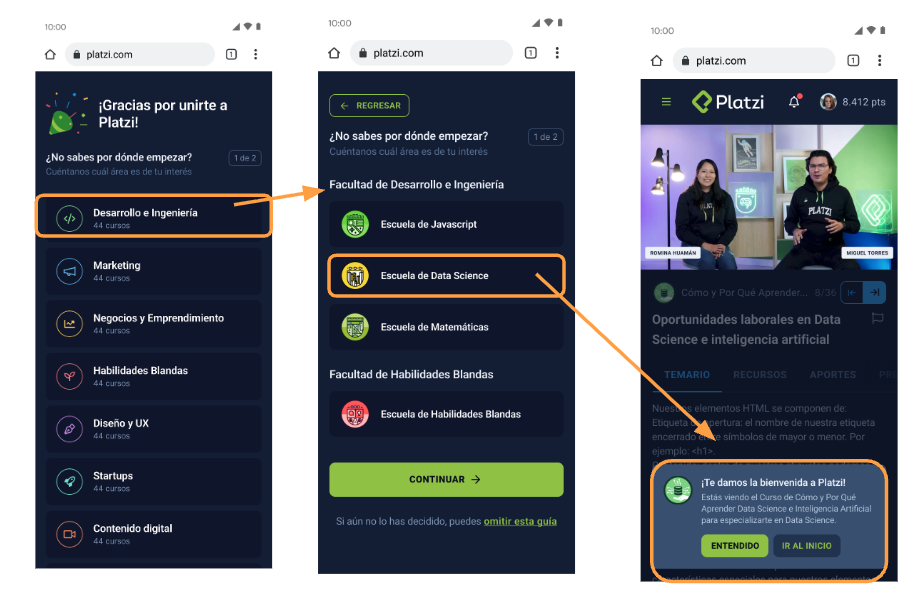
WAS increased in the first week after registration, but the effect didn't persist. By week two, students became inactive again.
Students didn't watch more than two classes of the recommended course, indicating limited sustained interest.
Some students were confused about why they arrived at a class immediately after registration, indicating a UX mismatch with expectations.
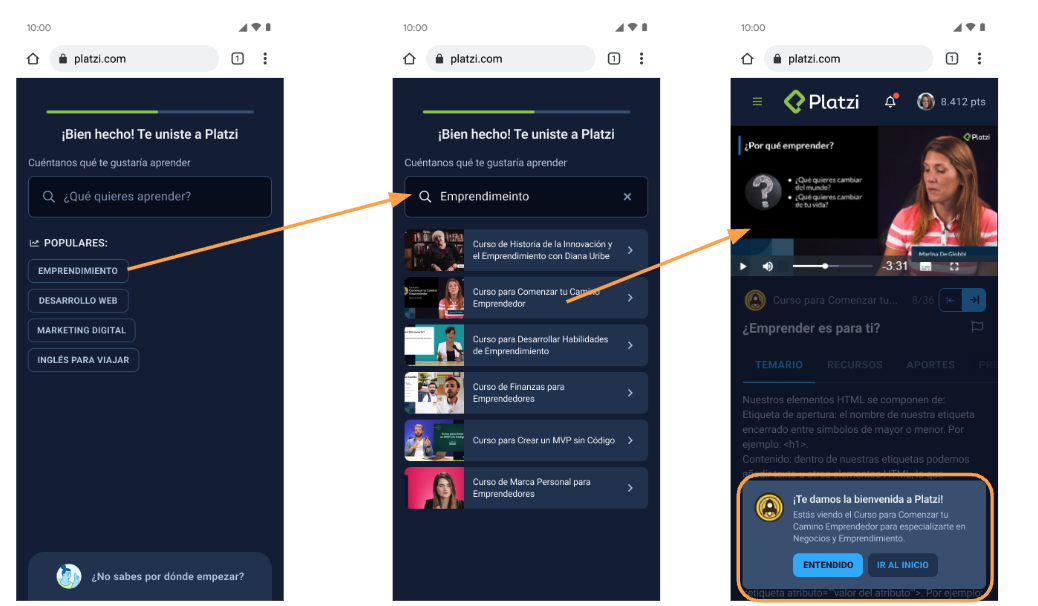
Testing whether giving students search functionality would help them find relevant content faster and reduce time to value.
When I register, the platform asks about topics I want to learn and suggests themes, but the terminology isn't clear, making it hard to find what I'm actually looking for.
If we give students the option to search for specific content instead of selecting from a list, we'll reduce time to value by helping them see relevant content quickly, impacting WAS.
More students found content they were interested in initially, showing the search approach had merit.
The solution didn't create lasting motivation beyond a couple of classes or one course.
Taking students directly to a class wasn't expected behavior. Students wanted to explore content before committing to start a course.
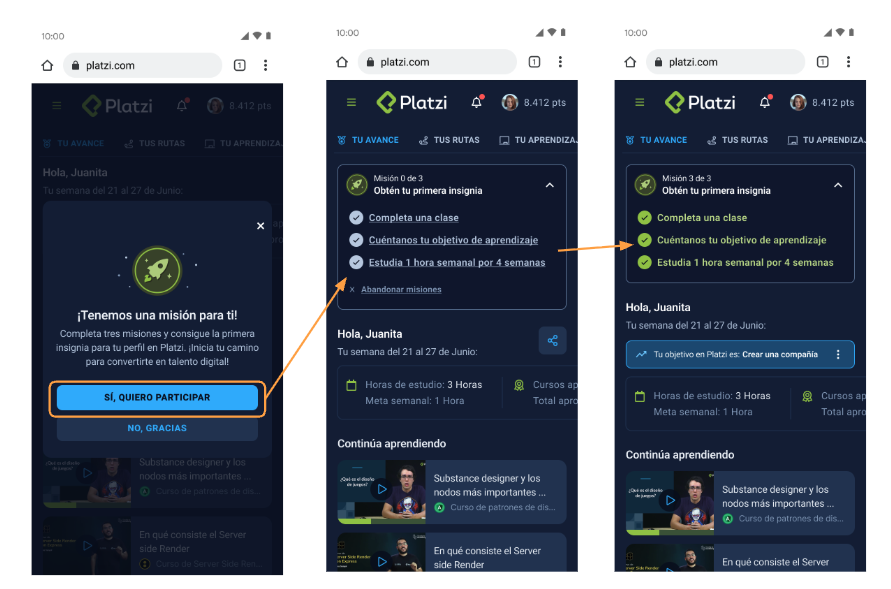
Testing whether gamified missions over 4 weeks would create sustained engagement and help students build lasting study habits.
After starting at Platzi, I lose interest because I don't find the motivation to study consistently.
If we create an extended onboarding with missions that students complete over 4 weeks, they'll stay active during weeks 2, 3, 4, and 5, increasing WAS for those periods.
Of all experiments, this achieved the strongest outcomes, successfully building study habits after the first month.
The missions element was engaging and fun, striking the perfect balance between exploration freedom and study motivation.
Students confirmed the gamified missions helped them discover Platzi's value and develop consistent product habits during month one.
The mission-based onboarding experiment delivered measurable improvements in student activation and retention.
Early experiments showed quick wins that didn't persist. The winning solution focused on building sustainable habits over weeks, not just immediate activation.
Students need structure (missions) but also autonomy (exploration space). Forcing them directly into content created friction; giving them a reason to engage worked better.
Combining quantitative metrics with qualitative interviews revealed the "why" behind results, enabling smarter iteration.
Simple gamification elements (missions, badges) can provide the external motivation needed to establish internal habits.